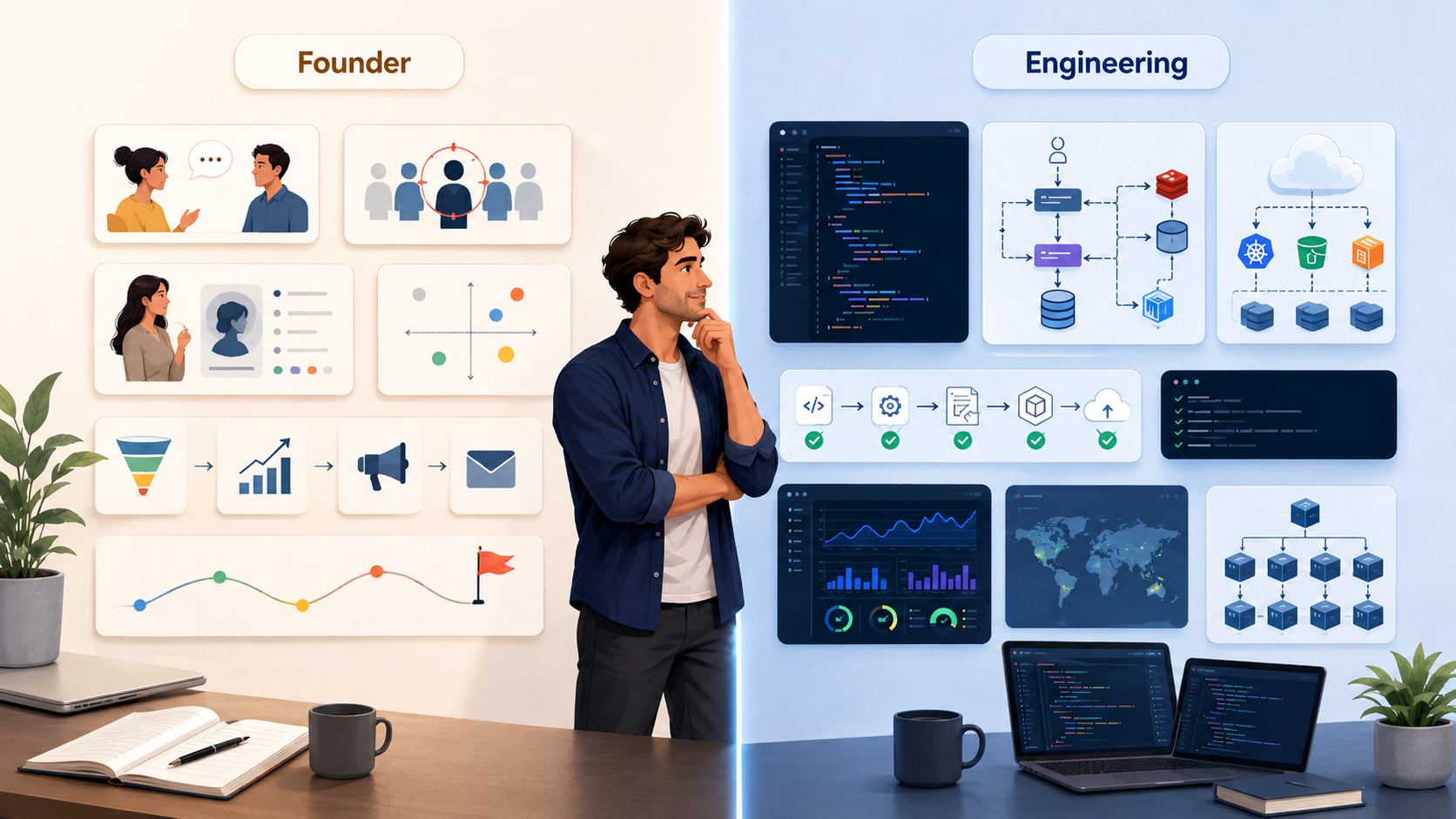
What solo founders should really focus on before turning a fast prototype into a serious software company
|
A prototype proves that something can be built. A company proves that somebody needs it, will pay for it, and can be reached repeatedly. |
The most dangerous advantage a solo founder can have is the ability to build. Product work feels concrete: every prompt creates a screen, every commit looks like progress, and every new feature produces an immediate sense of momentum. Company-building is slower and less comfortable. It requires talking to strangers, narrowing the market, hearing objections, asking for money and accepting that the original idea may be wrong.
AI and vibe coding have made this imbalance worse. A founder can now create a convincing prototype in days. That is genuinely useful, but it also makes it easier to spend months polishing a product before proving that a real business exists around it. The correct sequence is not idea, product, then customers. It is problem, market, ICP, persona, sales, go-to-market, marketing, sales process, and then serious product development.
1. Start with a narrow ICP
“Small businesses,” “startups,” and “people who need AI” are not ideal customer profiles. They are markets too broad to guide a product, message or sales process. Your ICP should define the type of organization most likely to experience the problem urgently, receive significant value, have the authority and budget to buy, and be reachable through a realistic channel. HubSpot (and, frankly, a lot of other sources) makes the distinction clearly: the ICP identifies which companies are worth targeting; personas identify the people inside those companies. [1]
Write your ICP as a testable hypothesis. Include industry, company stage, size, geography, technical readiness, buying trigger, existing alternative, budget range and urgency. Add exclusion criteria as well. Then tag every interview and opportunity against those attributes. The objective is not to describe your imaginary perfect customer. It is to discover which customers move fastest, understand the value immediately, pay without excessive customization and continue using the product.
Founder focus: Define who you will pursue, who you will reject and what evidence would make you change the ICP.
2. Understand the market, not just the idea
A large total addressable market does not prove that a startup has an opportunity. The founder needs to understand how the problem is handled today, who owns the budget, what event creates urgency, why existing options are inadequate and what the customer risks by changing nothing. Your real competition is often not another startup. It is a spreadsheet, a junior employee, an agency, an internal workaround or the decision to tolerate the pain for another year.
Study the market before committing to a roadmap. Interview potential customers and former buyers. Compare alternatives, prices, implementation effort and switching costs. Ask how the problem affects revenue, cost, risk or time. Not whether someone “likes” your concept. Research on early software startups found that teams often understand the need for problem-solution learning in theory but still prioritize product development in practice, neglecting the learning process their strategy requires. [2]
Founder focus: Find a painful, frequent and expensive problem with a credible budget and a reason to act now.
3. Separate the company from the buyer persona
Even with the right ICP, you can still talk to the wrong person. In B2B, the user, internal champion, economic buyer, technical evaluator and final approver may be different people. They experience the same product through different incentives. A user wants less friction. A manager wants a measurable operational result. A CTO wants security and maintainability. A CFO wants a defensible return. A founder who uses one generic message for all of them will learn slowly and sell badly.
Build personas from actual conversations, not invented biographies. Document each person’s responsibilities, KPIs, current workaround, personal risk, objections, buying authority and preferred proof. Use the language they use. Merge’s founders spent six months speaking with 100 companies before they had a solution, then learned through sales which roles had the power to move a deal forward. [3] That is what persona work is for: not for fancier decks, but understanding how a decision is actually made.
Founder focus: Know who feels the pain, who champions the solution, who pays and who can block the purchase.
4. Treat founder-led sales as "product research with tangible outcomes"
Early sales should not be delegated because it is one of the fastest learning systems available to a founder. A sales conversation forces precision. The prospect must understand the problem, believe the outcome matters, trust the solution and accept the price. Compliments, survey answers and waitlist signups can be useful signals, but a purchasing decision exposes urgency, budget, authority, objections and competing priorities at the same time.
The founders of Merge personally handled sales conversations for the first eight months and used each meeting to test messaging, demos, personas and pricing. [3] First Round’s founder-led growth guidance makes the broader point: founders cannot delegate the discovery of how the business grows at the zero-to-one stage. [4] Practitioner essays on Medium make the same argument from the field; technical founders often overinvest in product because selling feels unfamiliar, even though constant customer contact is how the first customers and the real roadmap are found. [5][6]
Founder focus: Run sales calls yourself, ask for commitment and money, record objections and change your assumptions every week.
5. Build a go-to-market plan before a feature roadmap
A go-to-market plan is not a launch campaign. It is the operating hypothesis for how one specific customer discovers, evaluates, buys, adopts and receives value from the product. It connects the market, ICP, persona, positioning, pricing, channel, sales motion, onboarding and retention loop. First Round’s early-stage GTM guidance warns that founders often emerge from the building phase with an MVP but no clear playbook for driving customers to buy. [7]
Choose a beachhead rather than trying to cover the entire market. Select one ICP, one urgent use case, one primary acquisition channel and one buying motion. Write a one-page GTM hypothesis containing the customer, problem, promise, proof, offer, price, channel, expected sales cycle, activation event and success metric. Test it with real outreach. A GTM plan that has not produced conversations and buying signals is still a theory.
Founder focus: Decide exactly how the first ten customers will find you, trust you, buy and reach value.
6. Make a system for marketing; random posting won't work
Marketing is not “being active” on every platform. It is the repeated creation of context, trust and demand around a defined problem. The marketing plan should specify the message, evidence, channels, content themes, cadence, conversion path and measurement. It should emerge from customer conversations and sales objections. Otherwise, the company produces generic content for an audience that may never buy.
At an early stage, start with product marketing: positioning, problem language, differentiation, use cases, proof and a clear call to action. A Medium essay by former Facebook and Google marketer Scott Brown argues that startups commonly blur sales and marketing and neglect the foundational messaging both functions need. [8] Do not outsource the core narrative before you understand it yourself. Specialists can improve distribution and execution later; the founder must first discover what the market responds to.
Founder focus: Build one clear narrative, publish proof, choose a small number of channels and connect every activity to a next step.
7. Turn the sales motion into a sales plan
The GTM plan explains the route to market. The sales plan converts that route into weekly behavior and numbers. Define pipeline stages, qualification rules, the objective of each meeting, follow-up cadence, proposal structure, expected conversion rates and forecasting method. Without this, founders confuse activity with progress and remember only the most promising conversations.
Work backward from the revenue target. How many deals are required? How many qualified opportunities produce those deals? How many first meetings create those opportunities? How much outreach is required to create the meetings? Track leading indicators such as outreach, replies, meetings, qualified opportunities, proposals, and lagging indicators such as revenue and churn. Document objections and the reasons deals are lost. This also creates the repeatable knowledge that a future sales hire can inherit.
Founder focus: Establish a weekly sales cadence, a visible pipeline and a feedback loop between lost deals, messaging and product priorities.
8. Then build the product; starting with a prototype
You still need something people can see and use. A prototype helps customers react to a concrete workflow instead of an abstract promise. AI-assisted development and vibe coding make this dramatically faster. Use that advantage. Build the smallest demonstration that tests the riskiest assumption, supports a sales conversation or delivers one valuable outcome. It can contain manual steps. It can be narrow. It does not need the infrastructure of a mature SaaS company.
But do not confuse the ability to generate software with the ability to operate a dependable product. Startup Genome’s research found that premature-scaling companies wrote substantially more code during discovery and often invested in product scale before validating problem-solution fit. [9] Once customers depend on the system, professional engineering becomes necessary: architecture, data design, authentication, permissions, reliability, security, observability, deployment, testing and maintainability. As I argued in Why Vibe Coding Needs Engineering Judgment, the value is not in protecting old coding habits. It is in using AI’s speed inside a delivery system where someone owns the trade-offs and accepts responsibility for what reaches production. [10]
Founder focus: Use the prototype to learn and sell. Use professional product engineering when the company has evidence worth building upon.
The founder’s real job is to build the company
A solo founder should not outsource customer understanding, positioning, sales or the discovery of a repeatable go-to-market motion. Those are the company. They determine what should be built, for whom, why it matters, how it will be sold and whether the business can survive. Building more product is often the comfortable response to uncertainty. It is rarely the highest-leverage response.
The better division of responsibility is straightforward: the founder owns the market, customer, commercial direction and product outcome. Experienced product and engineering professionals own the technical system required to deliver that outcome safely and sustainably. The founder remains close to the product without becoming the permanent bottleneck for every architecture decision, deployment problem and maintenance task.
Where DitchNow fits
DitchNow works with solo founders and early-stage companies at this exact boundary. You remain responsible for the customer, market, sales, positioning and company direction. We take ownership of technical execution: scope, architecture, AI integration, product development, production hardening, deployment and the measurement loop after launch.
The objective is not to take the product away from the founder. It is to stop technical execution from consuming the time the founder needs to build the business around it.
Sources and further reading
1. ICP vs. buyer personas. HubSpot, 2025. Read source
2. Why Early-Stage Software Startups Fail. Giardino, Wang & Abrahamsson / arXiv, 2017. Read source
3. Merge’s path to product-market fit. First Round Review, 2023. Read source
4. Founder-led growth playbook. First Round Review, 2025. Read source
5. Sales will solve almost all of your problems. Kyle Racki / Medium, 2018. Read source
6. Why founder-led sales matters before PMF. Together Fund / Medium, 2021. Read source
7. Early founder go-to-market questions. First Round Review, 2023. Read source
8. What founders get wrong about startup marketing. Scott Brown / Medium, 2025. Read source
9. Premature Scaling: A Deep Dive. Startup Genome, 2011. Read source
10. Why vibe coding needs engineering judgment. DitchNow, 2026. Read source